CIMdata PLM Industry Summary Online Archive
25 October 2007
CIMdata News
CIMdata Releases its 2007 PLM Market Analysis Report: Comprehensive Information and Analysis of the PLM Market
Consulting and research firm CIMdata announces the availability of its annual Product Lifecycle Management (PLM) Market Analysis Report. The 2007 report presents an analysis of the 2006 Product Lifecycle Management (PLM) market, with special emphasis on the collaborative Product Definition management (cPDm) segment of that market. In addition, an analysis of the Multi-discipline Mechanical Computer-Aided Design (MCAD) segment of the market is also included. This analysis provides CIMdata's perspective on PLM across a variety of industry and geographic sectors identifies market trends, reviews investments in PLM-related software and services during 2006, and forecasts PLM investments for 2007 through 2011. The forecasts are based on data available through the first quarter of 2007. It is important to note that the data and revenue information presented in this report are CIMdata's estimates of the PLM revenue performance of the various suppliers.
The PLM Market Analysis Report comes in two modules: 'Module 1' presents an overview of the PLM market, overall market statistics, and an analysis of PLM suppliers' performance in 2006. 'Module 2' builds on the information presented in Module 1 by providing detailed geographic and industry 2006 cPDm revenue results and forecasts from 2007 to 2011. The PLM Market Analysis Report is sold as a stand-alone report or as part of the CIMdata PLM Community Gold membership. Further details and pricing information about the report are available at http://www.cimdata.com/publications/reports.html .
CIMdata defines PLM as a strategic business approach that applies a consistent set of business solutions in support of the collaborative creation, management, dissemination, and use of product definition information across the extended enterprise, and spanning from product concept to end of life-integrating people, processes, business systems, and information. "PLM forms the product information backbone for a company and its extended enterprise ." explained Mr. Ken Amann, CIMdata Director of Research. "It is c omposed of multiple elements including: foundation technologies and standards, such as XML, visualization, collaboration, enterprise application integration; information authoring and analysis tools like mechanical design, electronics design, software engineering, technical publishing, finite element analysis; core functions including data vaults, document and content management, workflow, product structuring, program management; functional applications such as configuration management, engineering change control; and business solutions like new product introduction, supply chain collaboration, that incorporate best practices and methods." added Mr. Amann.
Mr. Amann further explained that CIMdata partitions the PLM market into two primary segments: cPDm and Tools. "Tools are focused on fundamental intellectual property (IP) creation and cPDm is focused on IP management including collaboration, visualization, vaulting, and sharing of product related information."
PLM Market Growth Exceeds Forecast
Regarding the PLM market performance, Mr. Amann said, "Our research shows that the overall PLM market grew 10.7% to reach $20.1 billion in 2006. This strong growth rate is attributed to continued recognition of the value of PLM in improving companies' business performance. PLM investments are forecasted to continue their climb over the next five years, increasing at a compound annual growth rate of approximately 8.5% to exceed an estimated $30 billion by 2011 ( as shown in Figure 1) .
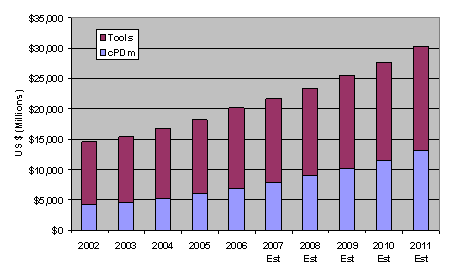
Figure 1-Overall PLM Market History and Forecast from 2002 through 2011
According to CIMdata, $13.2 billion was spent in 2006 by companies worldwide on PLM Tools such as mechanical computer-aided design (MCAD), computed-aided manufacturing (CAM), electronic design automation (EDA), engineering simulation and analysis, technical publishing, and others. Growth in this sector was primarily driven by investments in EDA and mid-range MCAD. Areas such as high-end MCAD and simulation and analysis experienced relatively lower growth. The Tools portion of the PLM market is forecasted to grow at a CAGR of 5.3% over the next five years to reach $17.1 billion by 2011.
The fastest-growing sector of PLM is for expenditures on cPDm, which is focused on collaboration, management, and sharing of product-related information. This segment covers technologies and approaches such as PDM, collaboration and visualization, data exchange, portfolio management, compliance management, strategic sourcing, enterprise application integration, workflow, functional applications such as configuration management, and solutions for specific industries or businesses.
CIMdata research indicates that the cPDm portion of the PLM market met the forecast for growth and reached $6.9 billion in 2006, representing an increase of approximately 13.6% over 2005. The cPDm segment is expected to continue its strong growth to $7.8 billion in 2007 and reach $13 billion by 2011 for a CAGR of 13.6% (as shown in Figure 2).
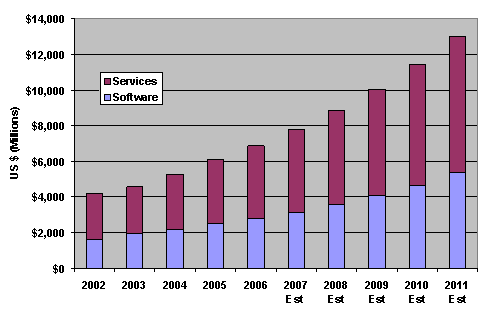
Figure 2 - cPDm Market Growth History and Forecast ( Estimated for 2007 to 2011 )
Wide Range of Companies Supply PLM-Related Solutions
Mr. Amann explained that a widely diverse group of suppliers provide PLM-solutions and services. Some of these suppliers focus on specific technologies or industries such as MDA, EDA, CASE, or analysis and simulation. Others deliver broad management and collaboration solutions that are the information backbone for PLM initiatives. Many PLM solution suppliers partner with suppliers of complementary technologies and applications in order to deliver more comprehensive enterprise PLM solutions than each could provide individually. Overall, companies from many different technology and service sectors derive substantial revenues from the PLM market.
Companies that have broad product suites designed to manage the full lifecycle - comprehensive technology suppliers - represent the foundation of PLM. These suppliers continue to expand their product suites to meet the needs of their customers. "Increased end-user investments are being driven by the continually-broadening scope of enterprise-wide implementations, expansion into new areas such as Digital Manufacturing, Strategic Product Planning, compliance management, industry-focused packaged solutions, and integration with other business initiatives such as Customer Relationship Management (CRM)," explained Amann. Both comprehensive PLM technology suppliers and focused application suppliers are packaging their products into solutions that focus on and support, the practices of specific industries (automotive, aerospace, high-tech electronics) and business problems, e.g. compliance. "The growth of supplier-developed 'packaged solutions' is significantly enabling small- and medium-sized businesses to adopt PLM solutions," according to Amann. "Mid-market investment in PLM continues to grow and PLM solution providers are fine-tuning their product suites and pricing models to better meet mid-market requirements for PLM adoption. PLM suppliers (such as Arena Solutions, Aras, and Contact Software) have differentiated themselves by focusing on small- and mid-sized businesses, Other suppliers such as Selerant, Infor, and Lascom are examples of companies differentiating themselves by focusing on specific industries. Many of the larger PLM suppliers provide multiple solutions, each focusing on specific industries and sizes of companies.
Independent consultancies, systems integrators (SIs) and value-added resellers (VARs) (e.g., Accenture, CSC, Deloitte Consulting, HP Consulting, TCS, T-Systems, etc.) continue to expand their PLM programs in response to the growing demand for such services. Major comprehensive technology suppliers expanded their direct service delivery programs and increased their development of alliances with SIs and VARs. "Consultancies and SIs are growing PLM programs by teaming with one or more of the comprehensive technology suppliers as well as expanding their own PLM knowledge staff," stated Amann.
Application suppliers focused on specific technologies and functions that are part of an overall PLM environment continue to expand the PLM footprint. Suppliers such as Accept Software, Centric Software, RuleStream, and Eurostep are examples of companies that are adding extended capabilities and value to PLM implementations. Examples of these expansion and/or niche areas include service-after-sales, strategic sourcing, and materials compliance solutions. The area of simulation and analysis continues to receive substantial emphasis, with expanded solutions to manage these environments and integrate them more fully into a full PLM program emerging and transitioning this sector of the market toward comprehensive enterprise simulation management (ESM) support. Suppliers such as MSC have been quite visible in driving this transition as well as the integrated simulation and analysis initiatives at major broad-based PLM suppliers like Dassault Systèmes and Siemens PLM Solutions Group.
All Geography and Industry Sectors See Strong Growth
CIMdata statistics indicate that cPDm growth continued in all industry and geographic sectors for 2006. Both EMEA (Europe, Mid-East and Africa) and the Americas maintained solid growth with the Americas growing at over 15% and EMEA up 13%. Asia-Pacific continues to be a major opportunity. While the 9.2% growth of the Asia-Pacific region was dominated by Japan, continued investment by solution providers in China and other AP countries should result in increased growth across the region in the coming years.
Mr. Amann said, "Our research indicates that the automotive and high-tech continue to be the largest cPDm adopters in 2006. Aerospace and defense (A&D) and fabrication and assembly (F&A), which includes white goods, machine tools, retail and apparel, and others, had solid revenues." He added that all process industry sectors had solid growth. This includes consumer-focused process industries (consumer packaged goods, food and beverage, and pharmaceuticals), petrochemical, and utilities. Shipbuilding, construction, infrastructure and non-traditional sectors also showed strength based on increasing adoption of PLM by those industries. "This across the board growth demonstrates the universality of PLM in providing business value across such a diverse spectrum of industries." noted Mr. Amann.
Become a member of the CIMdata PLM Community to receive your daily PLM news and much more.
Tell us what you think of the CIMdata Newsletter. Send your feedback.
CIMdata is committed to your privacy. Your personal information will never be sold or shared outside of CIMdata without your express permission.